Just back from a nine day trip to Braemar area. It's well known to us but, inexplicably, it's years since we've been there and so it all felt very fresh. Lovely. Now getting organised for another trip away, but I’ll try to write up a few reports before then. Mobile blogging would be so much easier than writing things up when back home.
"The spirit was already aloft, I was pulling on my boots" - W H Murray, Mountaineering in Scotland
Stuc a' Chroin and Ben Vorich
Tuesday, 13 September 2011
Braemar trip
Just back from a nine day trip to Braemar area. It's well known to us but, inexplicably, it's years since we've been there and so it all felt very fresh. Lovely. Now getting organised for another trip away, but I’ll try to write up a few reports before then. Mobile blogging would be so much easier than writing things up when back home.
Friday, 2 September 2011
Scottish Gamekeepers Association
The SGA has raised the question of whether a sea eagle could distinguish between its natural prey and children. The report can be found here. Oh dear, what next.
Wednesday, 31 August 2011
Short film about Ben Nevis area
| Ben Nevis |
Nice video about Ben Nevis area on Dave MacLeod's blog here. Also video and photographs of Dave in action in Norway and Scotland. Super climbing blog.
Monday, 15 August 2011
Saturday, 13 August 2011
Keen Targhee II Walking Shoe
Dark Shadow/Harvest Gold
I first bought a pair of these shoes in March this year and have been so pleased with them that I’ve just bought another pair from Webtogs. My first Targhee IIs were Mid boots bought in 2008 and although extremely comfortable, the eVent membrane was useless and I repeatedly had to use Super Glue to fix the grey ‘caps’ on the sole.
The new KEEN.DRY membrane is much more effective and overall construction seems to be better – the shoe feels sturdier. The old Targhees were a bit skittery on wet rock and grass but these new ones have coped well on a variety of terrain in, mostly, very wet weather. I can’t explain this because the sole doesn’t look very different from the 2008 version except maybe it’s a little more aggressive.
I’d have no hesitation in using these shoes on a long backpacking trip and plan to do just that next May. Now though, a local walk - in the rain as usual.
This second pair cost £47.50 from Webtogs - that’s half-price in a summer sale.
Approx 490g per shoe
Wednesday, 3 August 2011
MRT's get additional funding
An additional £204,000 funding for MRTs in England, Wales, Scotland and Northern Ireland has been announced by the government. This is apparently the first of four years funding with at least £200,000 available each year.
Teams in England and Wales will share £128,000, Scotland will receive £68,000 and Northern Ireland £8000.
Tuesday, 2 August 2011
St Monans salt pans
The East Neuk of Fife is generally regarded as comprising the fishing villages in the most northerly part of the Firth of Forth, although the exact boundaries are somewhat vague and disputed. Characterised by their small picturesque harbours, the likes of Pittenweem, St Monans and Crail are delightful places, but despite spending my student years at St Andrews University, I never got much further down the coast than The Maiden, The Rock and Spindle or occasionally Buddo Rock, none of which lies in the East Neuk.
The Windmill (Salt Mill) was used to pump sea water into the pans and once full, coal, which was readily available in Fife, was fired and the water evaporated off to leave the salt. To produce one ton of salt required about 32 tons of sea water. Salt duty was repealed in 1823 and the cheap imported salt from abroad saw the demise of the industry with the last salt pan in Scotland, at Prestonpans, closing in 1959.
The remains of a Panhouse and salt pans can still be seen on the shore below the windmill.Information boards provide the visitor with more information and during the summer months the Windmill is open to the public.
All in all, an enjoyable day out, even though not 'a foot' had been set upon a hill.
You can read more about salt extraction on Martin's excellent blog.
| Crail Harbour |
In April this year, however, shortly after Sir Hugh had walked the Fife Coastal Path, we decided to explore for ourselves, and from Crail harbour we walked along the coastal path to the prominent St Monans Windmill.
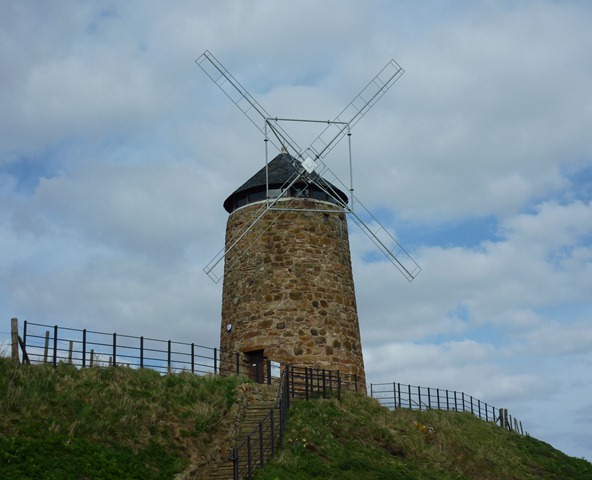
Salt panning was an important industry in Scotland in the 17th and 18th centuries, salt being a vital commodity in trade with continental Europe, and the introduction of a salt tax by Mary Queen of Scots transformed the activity into a commercial business which spread from the East Neuk of Fife to Prestonpans near Edinburgh.
The Windmill (Salt Mill) was used to pump sea water into the pans and once full, coal, which was readily available in Fife, was fired and the water evaporated off to leave the salt. To produce one ton of salt required about 32 tons of sea water. Salt duty was repealed in 1823 and the cheap imported salt from abroad saw the demise of the industry with the last salt pan in Scotland, at Prestonpans, closing in 1959.
The remains of a Panhouse and salt pans can still be seen on the shore below the windmill.
All in all, an enjoyable day out, even though not 'a foot' had been set upon a hill.
You can read more about salt extraction on Martin's excellent blog.
Saturday, 30 July 2011
Crail Festival
We were in Crail recently as the annual music and arts festival was getting underway. This beautiful sand scuplture rightly attracted much attention.
Tuesday, 19 July 2011
Trojan
Not been blogging recently since finding a nasty trojan downloader on the computer. I'm temporarily closing all photo albums since it seems to be uploading images and using my accounts so all these will have to be changed. All spy removers (and professionals!) have failed to get rid of it - I'm writing this on this on a new computer I've bought!!
Subscribe to:
Posts (Atom)